How to Calculate Percentage: Formulas and Examples
Percentages come up everywhere — tips, discounts, tax, exam scores, interest, and sales figures. Once you know the three core formulas below, you can work out almost any percentage in your head or on paper. This guide covers how to calculate a percentage of a number, how to find what percentage one number is of another, and how to calculate a percentage increase or decrease.
What a Percentage Actually Means
The word percent means “per hundred.” So 25% simply means 25 out of 100, or the fraction 25/100, which equals 0.25 as a decimal. Converting between the three is the key skill:
- Percent to decimal — divide by 100 (25% → 0.25)
- Decimal to percent — multiply by 100 (0.25 → 25%)
Every calculation below relies on this one idea.
1. How to Calculate a Percentage of a Number
To find a percentage of a number, convert the percentage to a decimal and multiply.
Formula:
Result = (Percentage ÷ 100) × Number
Example: What is 20% of 150?
(20 ÷ 100) × 150 = 0.20 × 150 = 30
This is the calculation behind tips and discounts. A 20% tip on a £150 bill is £30; a 20%-off discount saves you £30.
2. How to Find What Percentage One Number Is of Another
To express one number as a percentage of another, divide and multiply by 100.
Formula:
Percentage = (Part ÷ Whole) × 100
Example: You scored 42 out of 50 on a test. What percentage is that?
(42 ÷ 50) × 100 = 0.84 × 100 = 84%
3. How to Calculate Percentage Increase or Decrease
Percentage change tells you how much a value has grown or shrunk relative to where it started.
Formula:
Percentage change = ((New value − Old value) ÷ Old value) × 100
Example (increase): A price rises from £80 to £100.
((100 − 80) ÷ 80) × 100 = (20 ÷ 80) × 100 = 25% increase
Example (decrease): A price falls from £100 to £80.
((80 − 100) ÷ 100) × 100 = (−20 ÷ 100) × 100 = 20% decrease
Notice the two answers differ (25% vs 20%) even though the amounts are identical — because the starting value in the denominator changes. This is a common source of mistakes.
Quick Reference Table
| You want to… | Formula |
|---|---|
| Find X% of a number | (X ÷ 100) × Number |
| Find what % a part is of a whole | (Part ÷ Whole) × 100 |
| Add X% to a number | Number × (1 + X ÷ 100) |
| Subtract X% from a number | Number × (1 − X ÷ 100) |
| Percentage change | ((New − Old) ÷ Old) × 100 |
Common Real-World Percentages
- Tip: Bill × (Tip% ÷ 100)
- Discount: Price × (1 − Discount% ÷ 100)
- Sales tax / VAT: Price × (1 + Tax% ÷ 100)
- Profit margin: ((Price − Cost) ÷ Price) × 100
Skip the Math
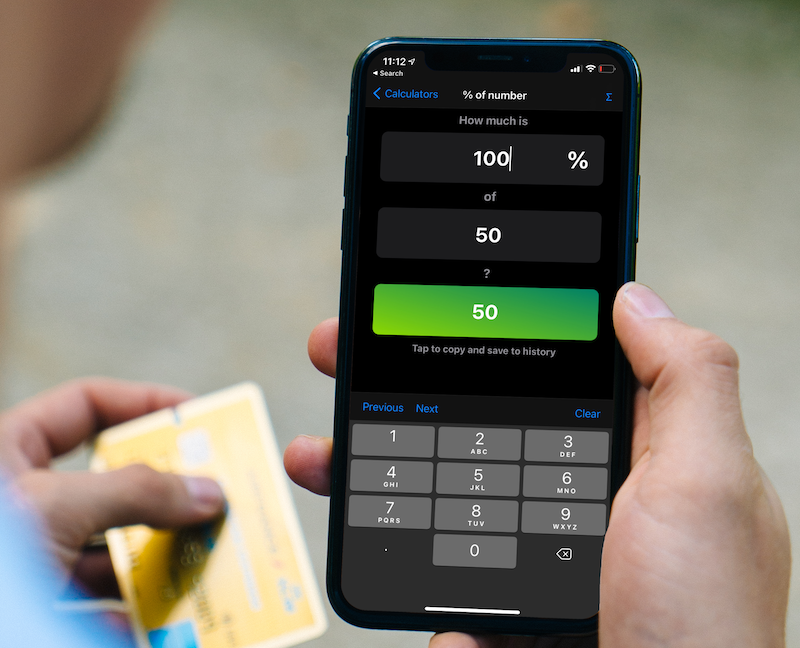
If you’d rather not reach for the formulas each time, Financial Calculator: Percent handles all of these instantly — percentage of a number, percentage change, tips, discounts, VAT, compound interest, ROI, profit margin and more.